
30 Years of the Supreme Court Summer Institute: Empowering Teachers to Build a Stronger Future
September 3, 2025
Share this Article
“SCSI is hands down the best professional development experience I’ve ever had. It transformed the way I teach civics and continues to be my top resource year after year. Supporting SCSI means investing in teachers who are empowered to create engaging, informed, and future-ready citizens. The impact on students is real and lasting.”
— Lisa Crabtree, Colorado
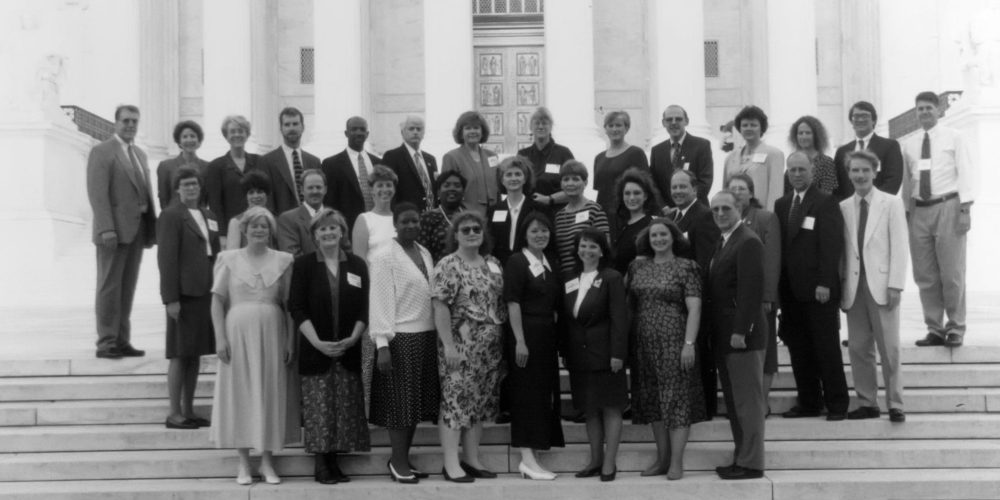
2025 marks 30 years of impact for the Supreme Court Summer Institute (SCSI)—a partnership between Street Law, Inc. and the Supreme Court Historical Society. Since its launch in 1995, the Institute has prepared thousands of teachers to translate the work of the Supreme Court of the United States into meaningful lessons for their students, helping young people across the country understand the Court’s role and impact in their daily lives.
Reimagining How the Court Is Taught
In the early 1990s, most high school government classes offered only cursory coverage of the Supreme Court. Landmark cases were often reduced to flashcard summaries. Students could recite “Gideon v. Wainwright—right to counsel” without grasping the lives affected or the constitutional principles at stake.
Street Law recognized an opportunity to change that. “Cases are stories about people that show how constitutional and statutory principles affect real lives,” recalled Lee Arbetman, Street Law’s retired executive director and an early architect of SCSI. Teachers could bring legal concepts vividly to life by grounding instruction in human stories and using interactive, student-centered methods.
To realize this vision, Street Law enlisted allies. The Supreme Court Historical Society led the way and supported the initiative, and a young attorney named John Roberts—later Chief Justice of the United States—offered early ideas and encouragement. In 1995, the first Institute convened at Georgetown Law, beginning what would become three decades of transformative professional development for educators.


Inside the SCSI Experience
From the outset, SCSI has combined substantive content, interactive pedagogy, and access to leading legal experts. Over the course of the weeklong Institute, teachers engage with appellate advocates, legal scholars, journalists, and Street Law staff. They study significant cases, practice strategies such as moot courts and deliberations, and explore materials in ways that model the student-centered instruction the program promotes.
These sessions are designed as conversations, not lectures. They bridge the world of the Court with classroom realities. “Having a deeper understanding of how the judiciary works—and being able to share stories from the people who are actually there—makes a huge difference in my teaching,” said Alyssa Watson of Omaha, Nebraska. “My students respond because it’s real.”
Teachers consistently emphasize the value of hands-on practice. “Participation in the moot court … made the cases come alive for me, and that energy carries into my classroom,” said Brian Kirchberg of Bradenton, Florida.
Street Law ensures that lessons are immediately transferable. Sessions on case analysis, constitutional interpretation, and interactive teaching strategies come with ready-to-use materials and time for teachers to adapt them to their classrooms. As participant Mary Stimson noted, “This is professional development you can put into practice the very next day.”
A highlight for many is attending decision day at the Supreme Court. “Hearing the justices announce opinions in person was unforgettable,” recalled Joe Kibler of St. Louis, Missouri. “It gave me stories and perspectives that make my lessons come alive.” Alyssa Watson added, “It allows me to paint a picture of the Court in ways students can grasp.”
By week’s end, participants leave prepared to make the Supreme Court accessible, accurate, and engaging—helping students to understand the Court’s role in democracy and to see themselves as active stewards of the rule of law.
The Multiplier Effect of Investing in Teachers
SCSI is more than a week-long professional development experience—it is the foundation of a community of support for civic educators. Street Law manages and supports this network, helping participants stay connected and providing ongoing resources and opportunities to engage with new cases and teaching strategies.
Nearly 2,000 educators from all 50 states have completed the program. Each of them teaches dozens to hundreds of students annually, creating a collective impact that reaches hundreds of thousands every year—and millions since 1995. With each school year, the impact multiplies as alumni continue teaching new classes.
Program evaluations show that participants leave more confident and continue using interactive strategies long after the Institute ends. Many alumni go on to lead civic education initiatives, reshape local curricula, and share insights with peers at district and state levels. “Attending SCSI deepened my understanding and gave me practical strategies I’ve used to develop lesson plans, lead activities like moot court, and support colleagues interested in bringing more civics into their teaching,” said Shiney Abraham of Houston, Texas.
Street Law’s curricular resources extend the impact. Alumni rely on tools such as SCOTUS in the Classroom, LandmarkCases.org, and LegalTimelines.org for curricular content throughout the school year. “The materials introduced to me through SCSI have made the law, courts, and civics come alive to my students. … They clamor for them,” said Ginger Attarian of Washington, DC.
The professional network remains vital as well: alumni stay connected online, sharing resources and collaborating throughout the school year. As Street Law senior program director Cathy Ruffing observed, “The alumni network is one of SCSI’s most powerful legacies. Teachers leave the Institute with a supportive community they can turn to for fresh ideas, problem-solving, encouragement, and advanced access to new materials and opportunities—long after their summer experience has ended.”
Why SCSI Matters Now
Today’s Supreme Court hears cases shaping presidential power, federal authority, and individual rights—all against a backdrop of political polarization, congressional gridlock, and fragile public trust in institutions. At the same time, many students graduate without a clear understanding of how the judiciary works—or why it matters in their daily lives.
For teachers navigating this landscape, SCSI provides both knowledge and reassurance. The Institute strengthens teachers’ confidence, expertise, and sense of professional community, helping them feel supported in a challenging educational environment.
Teachers leave with strategies to clarify complex legal issues, counter misinformation, and engage students in thoughtful discussions about the Court’s role in democracy. In turn, students participate more deeply in discussions of current cases and gain a clearer understanding of how constitutional principles shape their world.
Looking Forward, Expanding Access
The Supreme Court Summer Institute stands as a proven pathway for preparing teachers—and through them, millions of students—to understand, engage with, and safeguard the rule of law.
Each year, hundreds of educators compete for just 60 coveted SCSI seats. Street Law is committed to expanding the program and broadening teacher access so that more students can gain the civic knowledge and confidence to become active stewards of democracy.
“Investing in our nation’s teachers is investing in the foundation of democracy,” said Street Law CEO Ashok Regmi. “It’s about more than teaching about law and the courts—it’s about preparing the next generation to uphold it and use it as a tool for positive change.”
Street Law invites the legal community, school systems, and philanthropic partners to join this critical work. Your support can expand access, provide more teachers with essential resources and training, and ensure that students nationwide graduate with civic and legal knowledge and the confidence to apply it. Together, we can nurture informed citizens who will safeguard and strengthen our democracy.



